
This fizzy floral wine is a great way of extending the elderflower season from June to the whole of the summer and beyond. Get the recipe below.
Hedgerow Brews
My husband has been brewing beer for years but given I don't drink beer I didn't want him to have all the fun of making alcohol at home. So I've started to get into making my own hedgerow wines and other alcoholic drinks. In this post I'll teach you how to make my favourite hedgerow brew: Elderflower Champagne.
Elderflower Champagne is an alcoholic drink made from foraged elderflowers and champagne yeast. Elderflower Champagne has a subtle, perfumed pear flavour with a bit of dryness from the champagne yeast. I keep mine refridgerated to enjoy it nice and cold on a hot summer's day.
Is it safe to make Elderflower Champagne at home?
Some people may be worried about making their own alcohol. Moonshine (as homemade alcohol is sometimes called) has a bad reputation for making people sick. But, the good news is if you follow the principles of wine making then you shouldn't have anything to worry about.
The process of making wine (or even beer) is the same in your home as it is in a factory so it is just as safe as store bought! Follow the simple steps, practice good hygiene and you'll have delicious, perfectly safe, homemade alcohol in no time.
The only thing you have to worry about is getting soaked in wine if it gets too fizzy! But more on that below.
The science behind making Elderflower Champagne
I guess the first place we should start is the science behind making a fizzy edlerflower wine. Essentially, elderflower wine is an elderflower infused sugar and water mix. What separates it from elderflower cordial is that the natural yeast (or in this case champagne yeast) is given time to feed off of the sugars in the water, in doing so they begin to ferment creating alcohol and carbon dioxide bubbles!
By carefully measuring the ratios of water, sugar and yeast you can control how much alcohol and carbon dioxide is made. The recipe below should get you a fizzy wine that is roughly 11% ABV (provided the yeast behaves as expected!) It's amazing how incredibly simple it is to brew your own alcohol. Because it relies on yeast the scientific process really isn't all that different to making bread which, by the way, also produces small amounts of alcohol!
If you want to know exactly how alcoholic your champagne is before you drink it, you can take gravitational readings and follow a simple formula.
- Once you've dissolved the sugar in all ten litres of water you need to take your first reading.
- Fill the hydrometer tube up to about 2 inches from the top with the sugar water. Insert the hydrometer giving it a little spin as you do so.
- The hydrometer will slowly sink until it stops and bobs up and down gently.
- When the hydrometer comes to a stop, look at where the liquid intersects the markings on the hydrometer.
- Record the gravity reading - this is called your 'Original Gravity'.
- Repeat this process immediately before bottling. This is called your 'Final Gravity'.
- To get your ABV, subtract the Original Gravity from the Final Gravity then multiply this number by 131.25.
- If you like formulas then use the following: (FG - OG) x 131.25 = ABV %
What home brew equipment do you need?
You don't need a lot of equipment to get started. In theory you could just use a large bucket with a lid so long as it has all been properly sterilised. Your life will, however, be made much easier by having a proper fermentation bucket which will "self-burp" as the yeast produces carbon dioxide and will also have a tap at the bottom to make it much easier to siphon the champagne into bottles once it has finished fermenting.
You will also need bottles that are capable of holding carbonated drinks. There is always a risk that the pressure in the bottles will build up if the yeast is continuing to produce carbon dioxide. If you do not use the right type of bottle then you risk them exploding. I don't want to scare you but it is important to know that it's a risk which can be mitigated with buying the right bottles and burping them regularly if you suspect carbon dioxide is still being produced.
I do use glass swing top bottles but burp regularly. Occassionaly I will use plastic bottles with screw caps and I know some people like to re-use 2 litre soft drinks bottles. It's also possible to buy champagne bottles with corks. Check the listing carefully before purchasing.
How to bottle your Edlerflower Champagne
The bottle process is simple, sterilise your bottles and then fill them either using the tap on your fermentation bucket or by pouring the finished wine into the bottles using a funnel. It's that simple!
Knowing when to bottle your Elderflower Champagne is a little harder. To avoid the exploding bottles that I mentioned above, you want to wait until fermentation has slowed right down. If it's still regularly producing a lot of carbon dioxide then wait until this has calmed down before bottling.
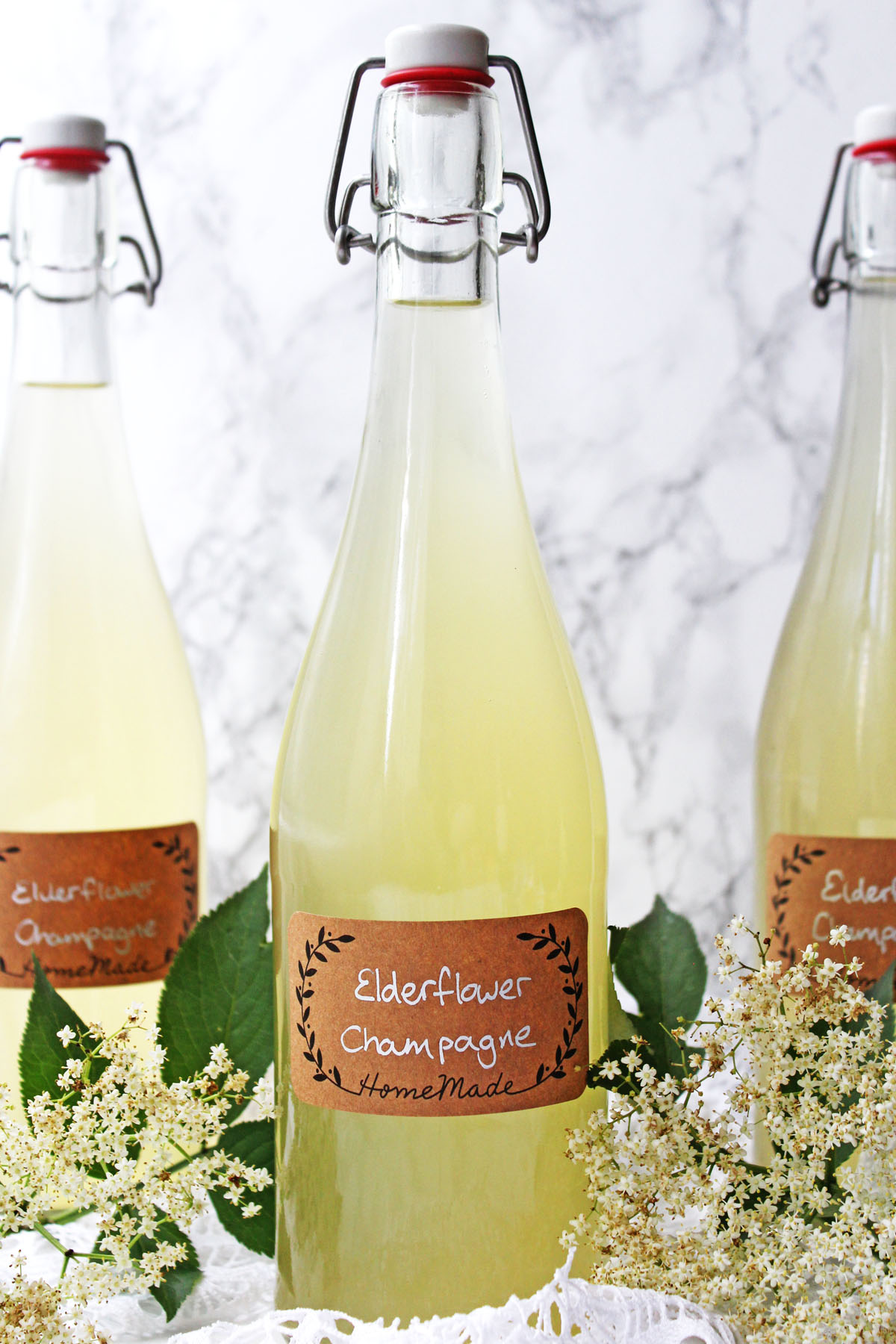
Foraging for elderflower
We've talked at length about how to make the Elderflower Champagne without stopping to talk about how to find elderflower in the first place. Here's a handy guide.
When is elderflower in season?
You will see elderflowers in hedgerows around the UK from May until August. At the end of the season, the flowers become berries (which you can also use in a range of recipes). The best time to pick elderflowers is on a warm, dry day - if they are wet they may be a little damp and musty.
Where does elderflower grow?
You can find elderflower growing right across the UK. Even in London you will see it growing in parks, along road sides and also along the train tracks (though don't go foraging for it there!) It often grows in amongst hedgerows and other small areas of trees.
I always try to avoid picking elderflower from near roads as they may have been contaminated with pollution. Similarly, I avoid picking elderflower that is low down in case a dog (or other animal) has used it as a toilet.
How to spot elderflower?
Elderflower plants are actually a type of small, flowering tree. It's their large clusters of small cream coloured flowers that make them easy to spot. Their leaves are also quite distinct as they are made up of 5-7 small oval “leaflets” with festery edges.
You will also know it's elderflower because they give off a wonderful sweet, perfumey scent.
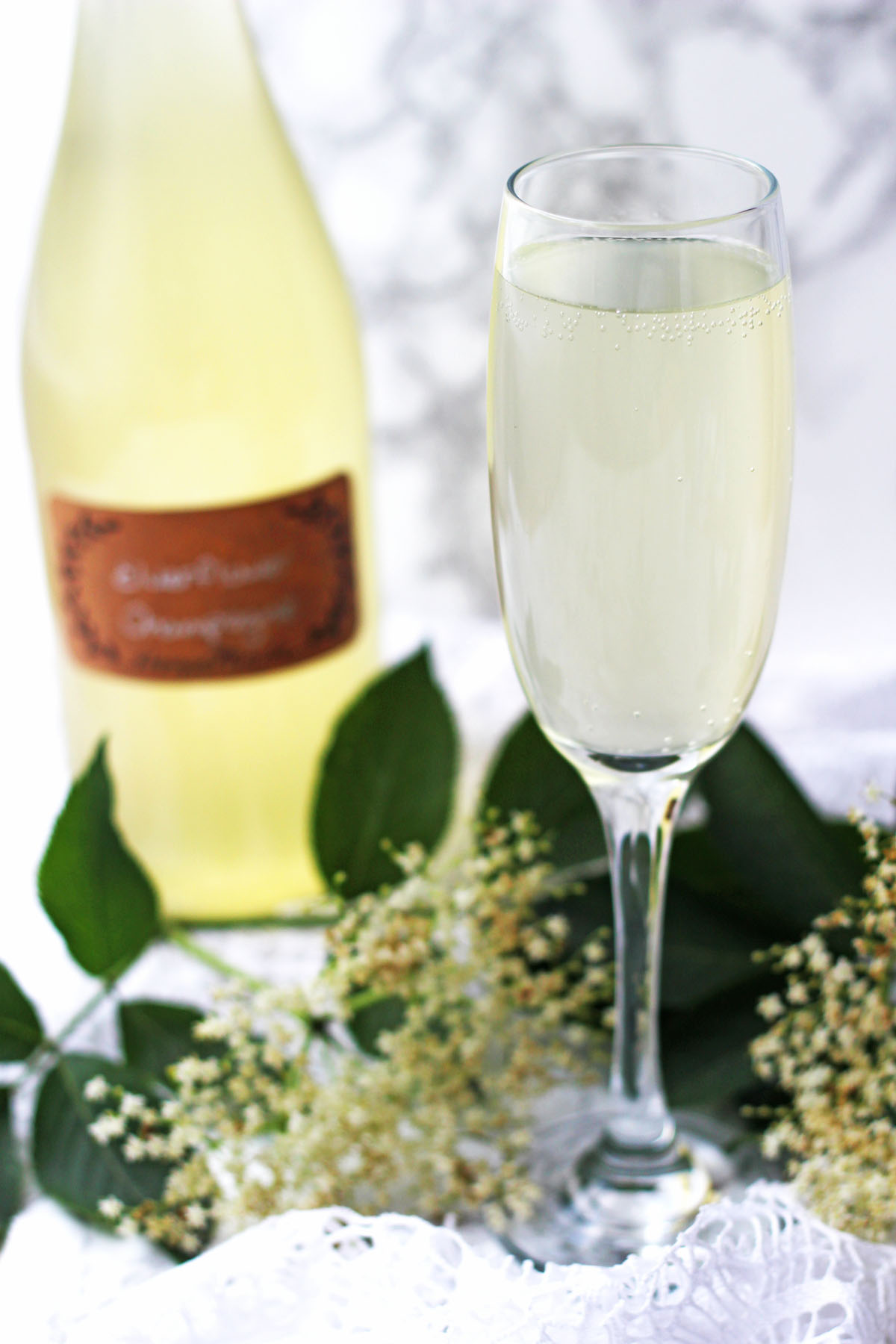
The Recipe
Now you know the theory, it's time to put it into practice. Enoy!
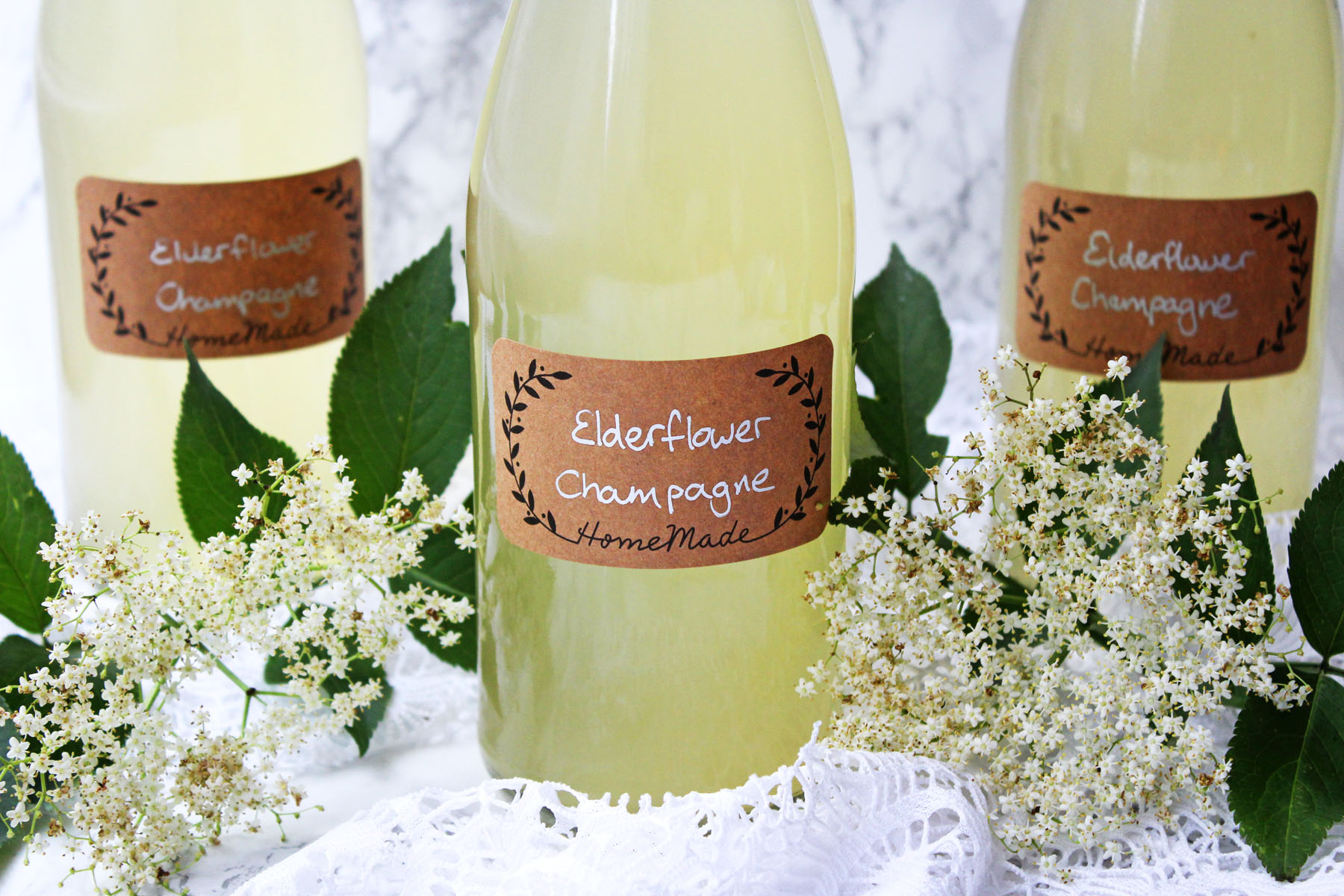
Elderflower Champagne
Equipment
- Fermentation bucket
- 10 x 1 litre champagne or wine bottles (must be suitable for holding carbonated drinks)
Ingredients
- 10 l water
- 1600 g sugar
- 30 florets elderflower
- 8 lemons zest and juice
- 5 g Champagne yeast
Instructions
- Begin by steralising all of your equipment. This can be done with a chemical steralising powder or by using soapy water and leaving to dry.
- Pour 4 litres of hot water in to your steralised fermentation bucket along with 1600g of sugar.
- Stir until the sugar has dissolved.
- Top up with the remaining 6 litres of cold water and add the elderflower florets, lemon zest and juice.
- In the meantime, activate the yeast with a little warm water and sugar (according to the packets instructions).
- Add to the sugar water and elderflower, stir well and put the lid on the fermentation bucket.
- Leave to ferment for 2 weeks.
- Strain the elderflower and zest from the champagne. Leave to rest for a further week before bottling in freshly steralised champagne bottles.
- If the champagne has lost a little fizz when you bottle, add a little syrup made from hot water and sugar (no more than 10g of sugar per litre).
Nutrition
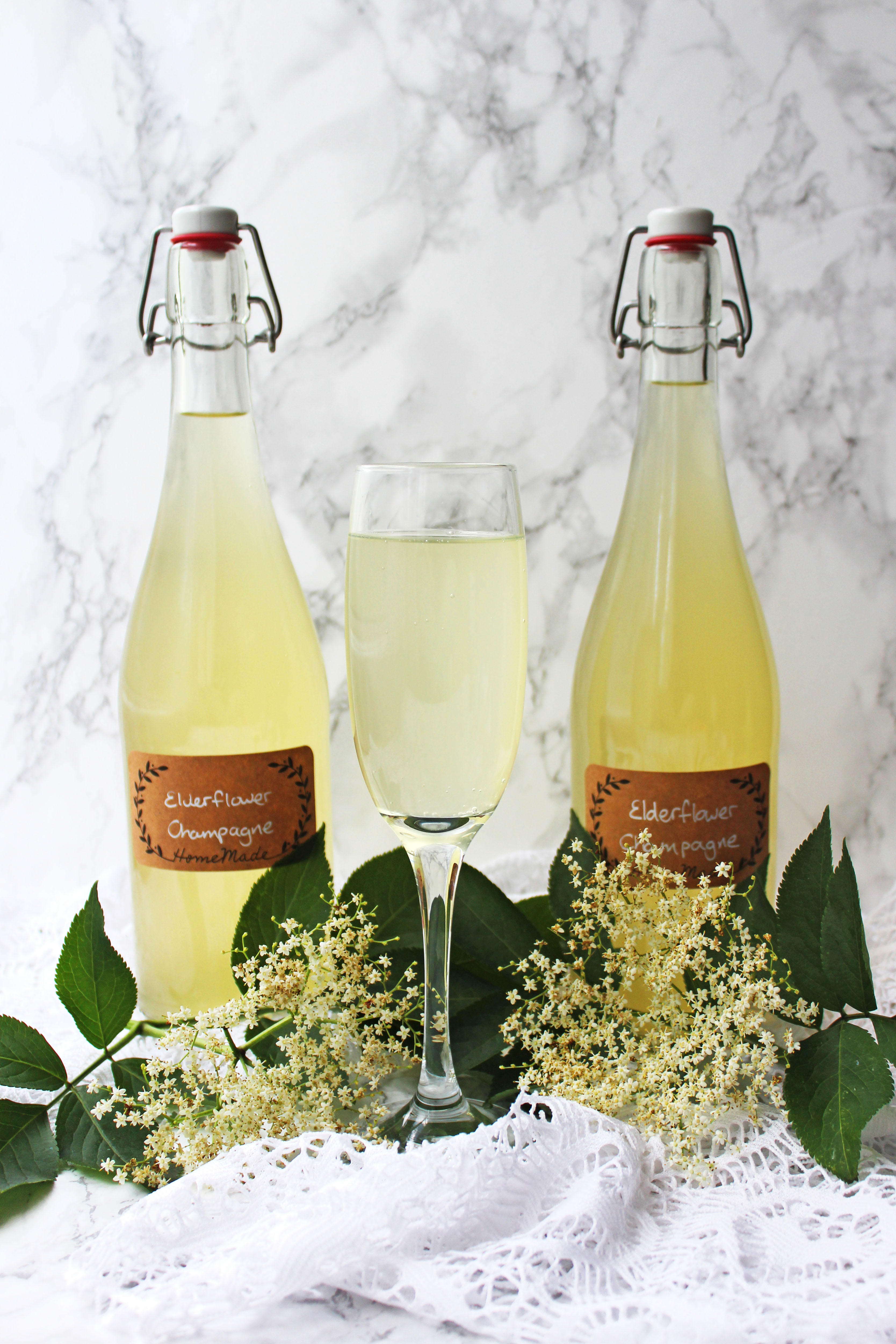
More elderflower recipes
More foraged foods

If you want to see more foraged foods, let me know! There's a whole wealth of tasty ingredients in our hedgerows and parks.
lisa @garlicandzest.com says
This is fascinating. I wouldn't have thought that making your own "champagne" was a "thing" but this looks and sounds so wonderful. I just have to find a fermentation bucket!
Emma Walton says
Hi Lisa. It is most definitely a "thing" and a tasty thing at that 😛 the French probably wouldn't be so happy with us calling it champagne but it is a truly delicious sparkling wine! You can get fermentation buckets really cheap on Amazon or just sue any large container with a lid!
Cathy @ Planet Veggie says
I currently have some elderflower champagne fermenting. Your recipe is a lot simpler than the one I'm following though!
Emma Walton says
Oh really? Where did you get your recipe from? Would be interesting to see how it differs! Good luck and I hope yours turns out well. We're still slowly working our way through the bottles and good news, none have exploded yet!
Choclette says
Oh, how interesting. This is the first time I've ever heard of anyone adding yeast. Is this done to make it more alcoholic? We've been making it in our family for more years than I care to remember and it goes very fizzy and slightly alcoholic, but relies on the natural yeasts present on the flowers. I missed the elderflower season altogether this year - feeling miffed 😉
Emma Walton says
It no doubt does make it more alcoholic. We're always a little nervy that there won't be much natural yeast present, this way we can guarantee a certain amount of fermentation in a set time period. Shame you missed the season this year. Fingers crossed you get to make a batch next year 🙂
Liz @ I Heart Vegetables says
That looks so delicious! I love a glass of chilled bubbly in the summertime. (Or let's be honest, all the time, haha.)
Emma Walton says
Hahaha I like your way of thinking Liz 😉 we cracked a bottle open this weekend just because!!! A lovely way to cool off in the summer sun 🙂
Elizabeth says
What a fantastic recipe! Love all of it - the bottles, the science, the colour, all of it! Super!
Emma Walton says
Thanks Elizabeth. I've been watching my OH brew for a while now and found the science behind it fascinating. I'm definitely still a novice but pleased to have cracked elderflower champagne! If only I could set up my own gin still...
Christie says
I have never seen a recipe for champagne before. I love it!
Emma Walton says
Thanks Christie. It is perhaps a little cheeky to call it champagne when it's made in a home kitchen rather than France but it doesn't sound quite as exciting as just "sparkling wine" 😛
Ludmilla says
I made many times before Elderflower syrup to make drinks using this delicious ingredient. I love the recipe of your champagne!!! Looks delicious.
Emma Walton says
Thanks Ludmilla you should definitley give it a try 😀
Kavey says
Elderflower champagne and cordial are some of the few things I've not tried to make as I know you have to get started as soon as you pick the flowers and get them home and I'm often slow to get moving! I do looove them though!
Emma Walton says
You really should Kavey! There are elderflower plants ALL OVER our patch of North London 🙂 will have to wait 'til next year now 🙁
Lucy says
I've never heard of champagne yeast but I NEED some in my life! What a marvellous project. I don't think I've found any nice elderflower trees before but I will make sure I keep an eye out for the next season.
Emma Walton says
Definitely do!!! The yeast is incredibly cheap actually. I thought it would be pricey just because it's "champagne" yeast 😛 good old Amazon 😉
Darren Campbell says
If I wanted to make 20 ltr’s would I double the ingredients?
Emma Walton says
Hi Darren, wow you must be having one hell of a party! Yes, just double the recipe! Enjoy 🙂
Darren Campbell says
Emma,
Thank you. Would it be the same for the yeast ? I have purchased those from Amazon you suggested, but they state 4.2 ltr to 22.6 ltr so would 10g be too much ??
Emma Walton says
Hi Darren. In that case Id stick with the one sachet. The yeast will sinply keep multiplying as it eats all the sugar! Let ne know how it goes 🙂
Darren Campbell says
Emma,
Where do I need to leave the fermentation bucket once ingredients are complete ?
Do I need to check or mix during the two weeks ??
Emma Walton says
Hi Darren, no need to mix or do anything special, just leave it be. I leave mine on the kitchen counter but not in direct sunlight or too close to a heat source like the oven. Just somewhere shady and with a steady consistent temperature, not too hot, not too cold. Hope that helps!
Darren Campbell says
Emma,
Great thanks for your advice much appreciated.
All systems go !! Will keep in touch if you don’t mind and let you know how it goes.
Emma Walton says
Absolutely. Would love to hear how you get on! I havent made any yet this year but I love how depending on the natural yeasts and age of your elderflower it changes every time 🙂
Michael says
Hi, definitely going for this recipe! Once you’ve siphoned it into the bottles, how long do you leave it for? Also, when adding the syrup if it’s lost fizz, is that 10g of sugar per litre of syrup, or 10g of sugar per litre of champagne? Thanks!
Emma Walton says
Hi Michael!
Best to leave it for a week. You can check on it in that time and release some of the pressure if the yeast is very active. If that's the case you can try it a little sooner.
Enjoy 🙂
Andy says
Hey Emma - have you ever tried making it without adding yeast - in other words relying on the natural yeast in the flowers? I'm going to try that tomorrow! Andy
Emma Walton says
Hi Andy, no I haven't though I know it is possible. I use the chamoagne yeaat so that I can have more consistency of flavour. I believe wild yeast also ferments more slowly so your carbonation levels will continue to increase over time. If you are planning on storing it for any length of time I would regularly "burp" the bottles to make sure there isn't too much pressure building up. Noone wants exploding bottles! Would love.to hear how you get on. I hope it works!!!
Caroline says
This sounds great, I do love the flavor of elderflower and the wonderful aroma. Sadly we don't get them where I am these days, but if I ever find them, this might have to be on the list!
Chef Markus Mueller says
I do make my own wine and beer, though haven't made a batch recently. I was gonna make some dandelion wine but ran out of time( flowers all went to seed) before I had a chance to go collecting.
I would love to try this at home...I wonder how long elderberry takes to grow!
Claudia Lamascolo says
Now this is unique to me I would love to try making this and the only draw back and I would hoard it all to myself!
Patty @ Spoonabilities says
How special and wonderful! This would be soooo amazing to share with a group of friends, no need for even a special occasion. This would make it a SO SPECIAL occasion!
camila says
This is absolutely brilliant!!! I am in love with this idea so so so much!! Your pics are beautiful too!! Totally in love
Philippa Mcqueen says
Hiya emma my fella &me have made elderflower champagne....ive been 'burping the bottles 'loads every day..x 3 have expldoded so were left with 10...it will be 7 days on saturday...some are still super fizzy and some sparkling....do you thi k i should mark & defizz only the super fizzy ones till day 7...or is this a sighn that they are ready to chill?x thanks x philippa x
Emma Walton says
Eek Phillipa it sounds like youve got some seriously fiery yeast on your hands! Sorry to hear some have already exploded despite the burping.
To avoid the rest having the same messy fate you need to slow down the rate of fermentation - Id defimitely recommend refridgerating.
What bottles are you using? Are they designed for holding fizzy drinks? Im wondering whether its worth you using more robust bottles. Weve even used old plastic fizzy drink bottles in the past.
One last tip - the champagne will lose a bit of fizz in the fridge so get it out an hour or so before serving so it comes up to room temp and gets fizzy again.
Pamela says
Couldn’t resist dipping my finger in bucket before bottling my elderflower champagne, it seemed very dry, stuck to recipe with precision. Have bottled it all
and hope it won’t be toooo dry x smells lovely though.!
Emma Walton says
Fingers crossed its not too dry for you - elderflower wines usually are on the dry end of the scale.
Darren Campbell says
Emma,
Not sure what’s happened I have followed recipe and have opened a bottle some four days after bottling.
There is no fizz and the taste is between vinagar and yeast.
Any suggestions other than dispose ??
Emma Walton says
Hi Darren so sorry to hear that, it is gutting. Ive only ever had one batch go bad on me like that. Its more than likely down to bacteria which produces acetic acid when it comes in to contact with your wine qnd oxygen. Frustratingly this bacteria is everywhere so whilst it could be down to your equipment not having been steralised properly there is a chance it was just bad luck. The warm weather probably hasn't helped either - if the temp is too low there's no fermentation but wiyh it as warm as it is now bacteria can thrive.
Rachel says
I've just had the same problem, tastes like vinegar and yeast...
Emma Walton says
Sorry to hear that Rachel - it sounds like it has fermented too long! Try the non-fermenting sugar. It may still be saveable!
David says
Think I might have let my champagne ferment a bit too long. Just had a wee sample to taste and it’s rather acidic.....any suggestions?
Thanks
David
Emma Walton says
Hi David
You will want to add a non-fermenting sugar, any artificial sweetener should do the trick!
All the best
Emma
Angela says
I'm preparing to embark on my first try making Elderflower champagne and I'm wondering if I need to use an airlock on the fermentation bucket? I'm also using dried Elderflowers. Any advice? Thanks! Angela
Emma Walton says
Hi Angela
I've never tried it with dried flowers and would be curious to know if they still have any natural yeast on them. So do let me know how you get on.
I've done it with and without an airlock so take your pick! If you don't use an airlock just burp the bucket every day or so to ket out any gas!
Sonia says
I didn't have time to do anything with my elderflower this year so i have it in the freezer. What dya reckon? Will it still make champagne or should I just make cordial
Emma says
Hi Sonia, I've not tried making it with frozen elderower personally but it should still work as we use champagne yeast in this recipe. The one thing I would avoid is using frozen stems, just use the flowers if you can. Do let me know how you get on.
Dee Cee Gee says
I've never used yeast and I've been making this for year. The flowers have quite sufficient natural yeast for it to ferment in 5-7 days. '
Emma says
Hi Dee, I do know people who rely on the natural yeast but I've had trouble in the past and find this more consistent. Thank you for sharing your experience.